


How to Choose a Holiday Rental Management Company
Handing your property to a third party is a significant decision. The right holiday rental management partner lifts occupancy, protects your asset, and frees up your time. The wrong one costs you money, guests, and sleep. Here is a practical guide to making that choice with confidence.
What a Holiday Rental Management Company Does
Core Functions
A holiday rental management company takes over the tasks that turn a vacant property into a revenue-generating guest experience. That covers marketing across booking platforms, setting and adjusting nightly rates, screening guests, coordinating check-ins, arranging cleaning between stays, and handling maintenance calls at midnight.
The terminology can be confusing. A short term rental agency typically focuses on urban apartments and high-turnover inventory, prioritising volume and platform reach. A holiday home management company tends to offer a broader, more hands-on service across a managed portfolio. A cottage rental agency sits in a different niche again, specialising in rural retreats, heritage cottages, and seasonal destinations where local knowledge and a slower, relationship-driven booking cycle matter more.
Who Benefits and When
Owners who live far from their property, work full-time, or lack the hospitality background to handle guest expectations professionally are the obvious candidates. The value proposition is concrete: managed properties routinely achieve 10–25% higher annual revenue than self-managed equivalents, driven by professional pricing tools and wider distribution. If your goal is stronger average daily rate (ADR), higher occupancy through shoulder seasons, and zero operational headaches, a management company earns its fee.
Services and Scope to Expect
Marketing and Distribution
Effective holiday property management starts with visibility. Expect a competent company to distribute your listing across Airbnb, Vrbo, Booking.com, and their own direct booking website, then layer on metasearch and social retargeting to capture demand that OTAs miss. Listing optimisation — keyword-rich descriptions, professional photography, competitive positioning — is table stakes, not a premium add-on.
Dynamic pricing is equally critical. The best operators use revenue management software to adjust rates daily based on local events, competitor availability, and booking pace. They also enforce minimum-stay rules strategically to protect weekends and peak dates while filling midweek gaps.
Operations and Guest Experience
Guest screening, pre-arrival communication, digital or in-person check-in, and round-the-clock issue resolution are the operational backbone. Response time matters: guests who wait hours for answers leave bad reviews. Ask what the guaranteed response window is before you sign anything.
Property Care and Compliance
Holiday accommodation management involves more than guest-facing work. Cleaning standards, linen turnover, restocking consumables, and preventive maintenance scheduling all sit under this umbrella. Regulatory tasks — short-term rental permits, annual safety checks, liability insurance guidance — are increasingly important as local councils tighten rules across popular destinations. A company that handles these proactively saves owners from costly fines.
Fees, Pricing Models, and Contract Terms
Common Fee Structures
Commission-only models are the most common in holiday rental property management, typically ranging from 15% to 30% of gross booking revenue. Hybrid models charge a lower commission plus a flat monthly fee for property care. Fixed-fee models suit owners who want predictable costs regardless of occupancy. None is inherently better — it depends on your revenue expectations and how involved the company is in day-to-day operations.
Watch the add-ons. Cleaning fees, linen charges, restocking costs, maintenance markups, and marketing levies can inflate the true cost well beyond the headline commission. Always ask for a total-cost simulation based on your property's projected revenue.
Key Contract Clauses
Exclusivity clauses prevent you from listing elsewhere — assess whether the trade-off in reach is worth it. Term lengths of 12 months are standard; anything longer needs a clear early-termination clause. Check the notice period required to exit the contract and what happens to your listings and booking data if you leave.
Owner payout cadence varies: some companies pay monthly, others within seven days of checkout. Understand how security deposits are held and how damage claims are processed before a dispute arises. Request a sample owner statement and a fee calculator — companies that refuse this are worth avoiding.
Experience, Market Coverage, and Specializations
Track Record and Reviews
Verified third-party reviews on Google and Trustpilot carry more weight than testimonials on a company's own website. Ask for case studies showing occupancy rates, ADR, and RevPAR compared against the local market. A company that cannot benchmark its results against market data is either underperforming or not measuring performance properly.
Ask specifically how they handle low season. Seasonality strategies — promotional pricing, flexible minimum stays, partnership with local event organisers — separate genuinely capable operators from those who coast on summer demand.
Property Types and Locales
A national operator may have brand recognition and technology infrastructure but limited knowledge of your specific postcode. A boutique cottage rental agency may know every local plumber and the exact guest profile that books Easter breaks in your area. Neither is universally superior. The right choice depends on your property type — urban flat, coastal villa, rural cottage, or luxury home — and how much local nuance matters in your market.
Marketing Engine and Technology Stack
Demand Generation
Check the company's channel mix. OTA dependence is a risk; direct bookings reduce commission costs and build a repeat guest database. Email marketing to past guests and social retargeting campaigns are signs of a company investing in demand generation rather than just riding platform traffic.
Owner Visibility and Control
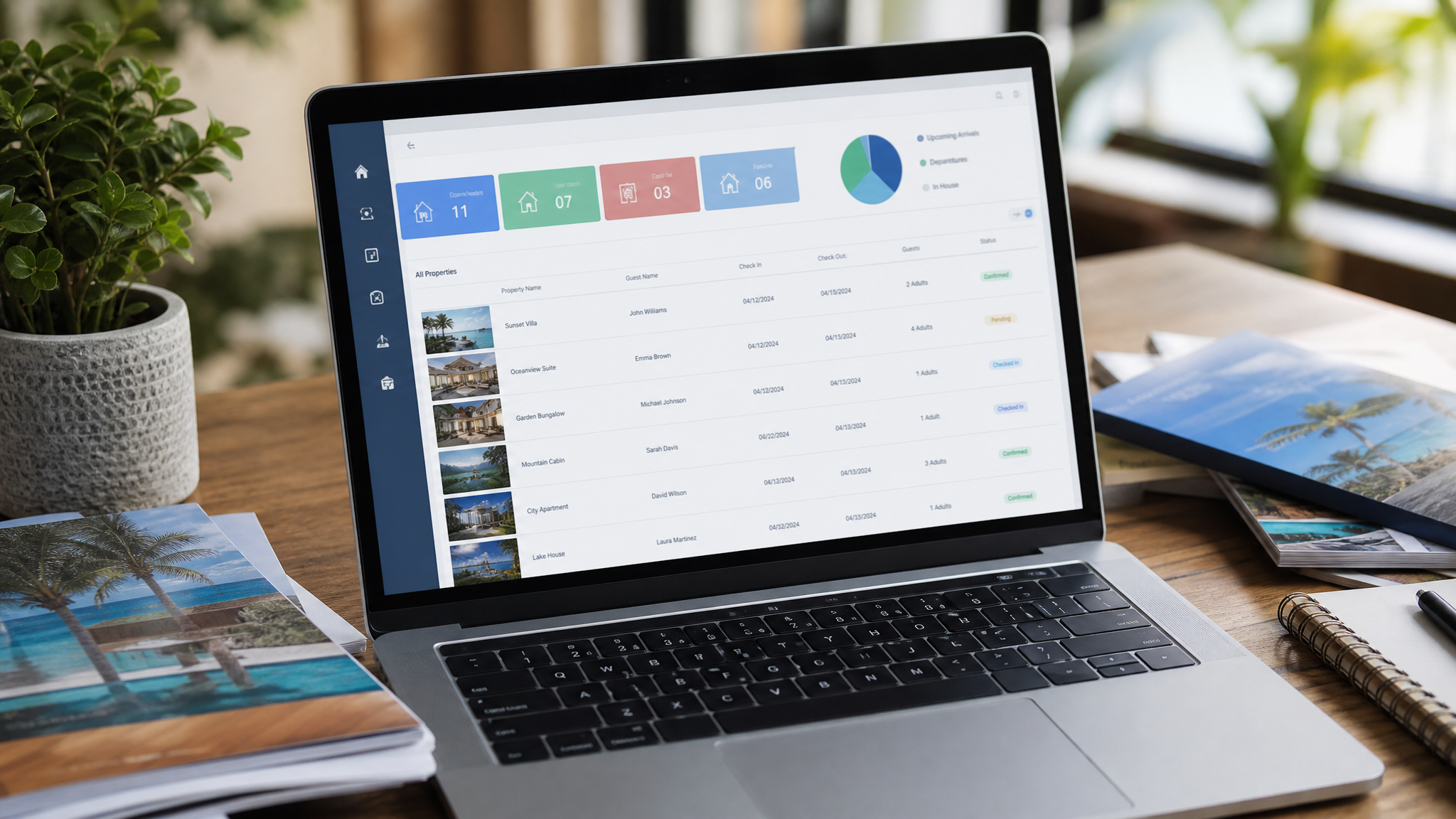
Technology should work for you, not just the company. A quality property management system (PMS) with a channel manager, dynamic pricing integration, and smart lock connectivity is now standard in credible holiday homes property management operations. Equally important is the owner portal — a dashboard where you can view your calendar, download statements, approve maintenance spend, and block personal-use dates without calling anyone.
Ask about A/B testing on listing content, length-of-stay optimisation, and gap-night fill strategies. These revenue science practices can add 8–15% to annual income with no additional marketing spend. Confirm that your data is yours and that integrations are documented — portability matters if you ever switch providers.
Due Diligence: Questions to Ask and Red Flags
Interview Checklist
Before signing, request a sample 90-day revenue plan for your property. Ask who handles guest messaging and what the guaranteed response time is. Demand proof of insurance, licensing, and how contractors are vetted. Get clarity on damage-claim workflows and dispute resolution — vague answers here predict difficult conversations later.
Ask for a cleaning and turnover SLA. If they cannot tell you exactly how long a standard clean takes and what the quality check process is, standards will drift.
Warning Signs
Vague or bundled fee structures that resist itemisation. No local team — just a remote call centre. Reviews that highlight slow maintenance responses or unresolved guest complaints. A pricing methodology that amounts to "we set rates based on experience." These are not minor concerns; they are patterns that repeat across every owner relationship.
Onboarding, Transition, and Measuring Success
Smooth Handover
A structured onboarding process covers listing rebuilds, fresh photography, pricing setup, and a compliance audit. Vendor onboarding — cleaners, maintenance contractors, key holders — should be completed before the first guest arrives, not improvised afterward. A preventive maintenance calendar reduces emergency costs and protects your asset long term.
Performance Tracking
Set clear KPIs from day one: occupancy rate, ADR, RevPAR, average booking window, and five-star review rate. Schedule quarterly performance reviews with your account manager. Establish from the outset what good looks like and what triggers a conversation about switching providers.
Finally, define your exit plan before you need one. Your listing content, guest data, and booking history should be portable. Any holiday rental management company confident in its performance will not resist putting that in writing.