

How to Get More Vacation Rental Bookings: A Complete Guide
What Vacation Rental Management Is and How Bookings Really Happen
Vacation rental management covers every operational decision that drives occupancy and revenue — from the moment a traveler types a search query to the moment they leave a five-star review and book again. Understanding that end-to-end flow is the foundation for any strategy designed to get more vacation rental bookings.
The booking funnel has four distinct stages: search visibility, inquiry, conversion, and repeat stays. A property that ranks well on Airbnb but has weak photos loses guests at the conversion stage. A property with stunning photos but slow response times loses them at inquiry. Every stage leaks revenue if left unmanaged.
Platforms vs Direct Bookings
OTAs like Airbnb and Vrbo deliver instant traffic, built-in trust signals, and payment infrastructure. The trade-off is commission fees running 15–20% and limited access to guest data. A direct booking channel — your own website with a booking engine — costs more to build but yields higher margins and lets you market to past guests directly. Most successful operators run both, using OTAs for acquisition and direct channels for retention.
Success Metrics to Track
Before optimizing anything, establish your baseline KPIs. Occupancy rate tells you how often your calendar is filled. Average daily rate (ADR) tells you what you're earning per night. RevPAR — revenue per available room — multiplies both into a single performance number. Conversion rate tracks how many listing views become confirmed reservations. Review score ties all of it together, because a 4.6 rating ranks lower and converts worse than a 4.9.
Optimize Your Listing to Increase Airbnb Bookings and Visibility
Platform algorithms reward listings that generate clicks, bookings, and satisfied guests. That means listing quality isn't just a marketing exercise — it directly determines how often you appear in search results.
Start by auditing competitor listings in your market. Identify gaps: amenities they lack, policies that create friction, or photos that fail to tell a visual story. Those gaps are your opportunities.
Search Ranking Factors
Airbnb and Vrbo weight several factors heavily: response rate, booking conversion, review score, and listing completeness. Enabling instant book alone can lift search placement significantly, because it removes the approval delay that costs platforms completed transactions. Set a response SLA of under one hour and maintain it consistently.
Irresistible Listing Content
Write a title that combines a unique value proposition with local demand drivers — for example, "Waterfront Cabin with Private Dock — 5 Min to Downtown Asheville" outperforms "Cozy Cabin Near Asheville." Your summary should answer the traveler's core question: why this property over the dozens nearby?
Photo quality is non-negotiable. Shoot 20 to 40 professional images, lead with a strong cover photo that captures the property's best angle in good light, and add descriptive captions. Refresh seasonal shots twice a year to keep the listing current.
Conversion Boosters
Structure amenities clearly and honestly. Guests who arrive to find the "fully equipped kitchen" lacks a coffee maker leave angry reviews. List what you have accurately, highlight standout features prominently, and write house rules that set expectations without reading like legal disclaimers. Smart cancellation policies — offering a moderate or flexible option during shoulder season — can meaningfully lift conversion among undecided travelers.
Smart Pricing and Occupancy Strategy for Short Term Rentals
Flat rates leave money on the table in peak periods and empty calendars in slow ones. Dynamic pricing solves both problems.
Dynamic Pricing Tactics
Tools like PriceLabs, Wheelhouse, or Beyond connect to your OTA calendars and adjust rates automatically based on seasonality, local events, lead time, and your comp set's availability. A tool like this can increase RevPAR 10–30% compared to manual pricing simply because it reacts faster than any human can.
Run weekly rate audits: compare your ADR against occupancy. If occupancy is above 85%, your rates are probably too low. If it's below 60%, examine whether pricing or listing quality is the bottleneck.
Calendar Discipline
Orphan nights — single open nights between bookings — kill occupancy. Configure automatic gap-filling discounts to make those nights attractive without discounting across your whole calendar. Set minimum stay requirements strategically: a 3-night minimum on weekends in high season, dropping to 2-night or 1-night during midweek gaps.
Revenue Management Basics
Among the most effective vacation rental occupancy tips is building shoulder-season packages. A "Spring Weekday Escape" promotion priced 15% below peak rates with flexible check-in can fill nights that would otherwise sit empty. Last-minute deals — triggered automatically when nights remain open within a 7-day window — capture price-sensitive travelers who book impulsively. Length-of-stay discounts (7% off for 7 nights, 15% off for 14) attract the longer-stay guests who improve occupancy without increasing turnover costs.
Short Term Rental Marketing Across OTAs and Direct Channels
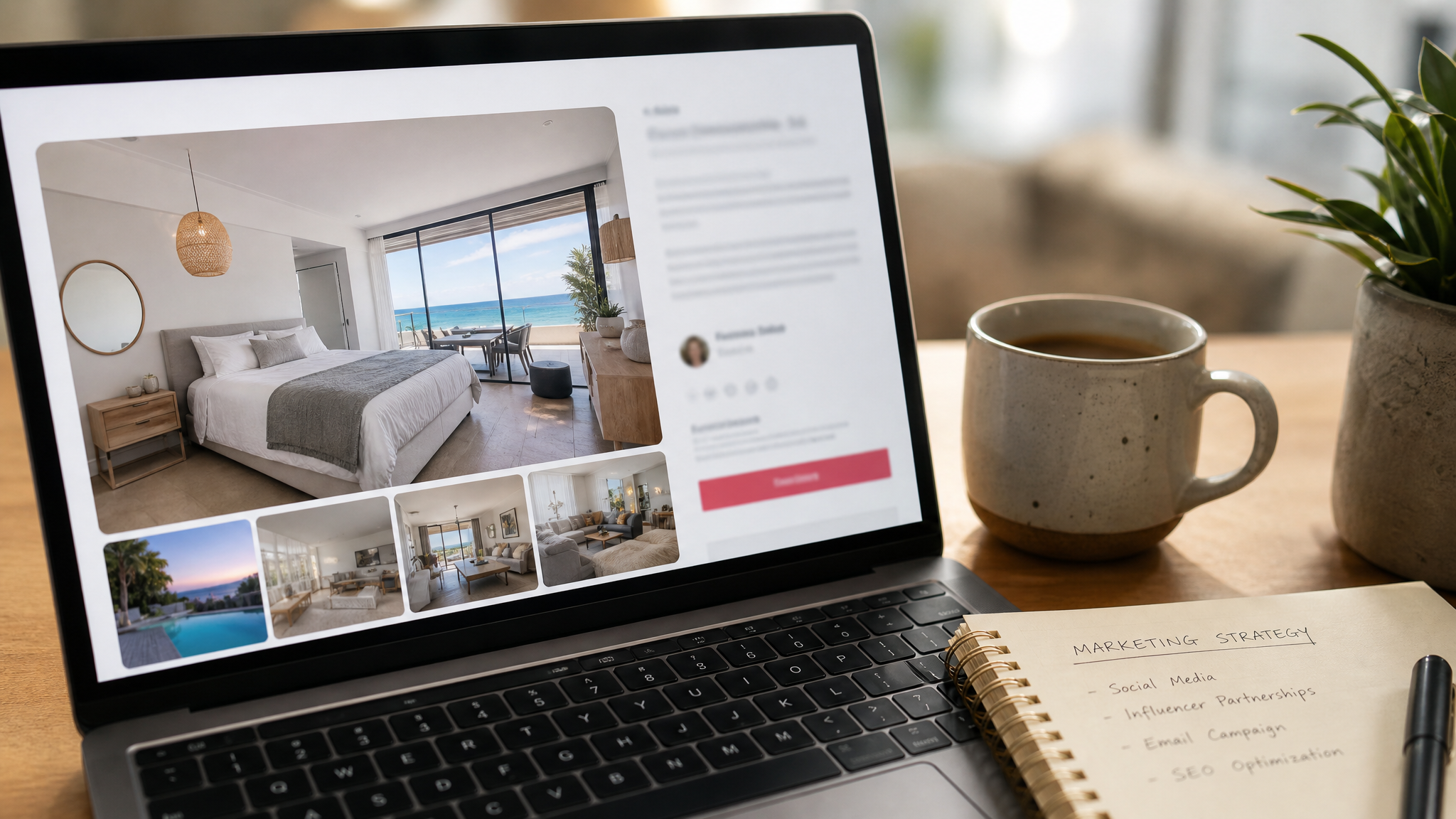
Listing on one platform is a single point of failure. Multi-channel distribution expands reach and insulates you from algorithm changes or policy shifts on any one platform.
Multi-Channel Distribution
A channel manager — tools like Guesty, Hostaway, or Lodgify — syncs your calendar, rates, and availability across Airbnb, Vrbo, Booking.com, and your direct site simultaneously. Without one, managing multiple platforms manually creates double-booking risk and operational chaos.
Direct Booking Engine
Your direct website should load in under three seconds on mobile, present clear calls to action, and connect to a secure booking engine that accepts major credit cards. SEO-optimized location pages — targeting searches like "cabin rentals near Asheville" or "beachfront vacation home [city]" — pull organic traffic that costs nothing per booking. This is where short term rental marketing compounds over time: content and backlinks you build today keep generating traffic for years.
Retargeting ads on Meta and Google re-engage visitors who browsed your site but didn't book. Email nurture sequences — a post-inquiry follow-up, a seasonal promotion, a past-guest win-back — convert warm leads that OTAs would never let you contact.
Audience Growth
Reach out to local businesses, tourism boards, and travel bloggers for referral partnerships and backlinks. A link from a regional tourism site carries SEO value and sends genuinely interested travelers your way. These partnerships cost little beyond relationship-building effort and often outperform paid ads on a cost-per-booking basis.
Guest Experience, Reviews, and Reputation Flywheel
Five-star reviews are the most durable competitive advantage in vacation rentals. They improve platform ranking, increase conversion, and make every marketing dollar work harder.
Pre-Arrival to Checkout
Automate a pre-arrival message that delivers check-in codes, parking instructions, WiFi details, and local restaurant recommendations. Guests who receive this information proactively ask fewer questions and arrive with better expectations. It also signals professionalism before they've even walked through the door.
Service Standards
Set cleaning and amenity standards that exceed what your listing price implies. Fresh linens, a welcome basket, and a spotless kitchen cost relatively little but generate the kind of surprise that turns into a glowing review. Resolve maintenance issues during stays rather than after — a proactive "We noticed the hot water heater has been slow; a technician is coming Thursday" message lands far better than a complaint.
Review Acquisition
Send a review request 24 hours after checkout, when the experience is fresh. Keep the message warm and specific, not templated. Respond publicly to every review — positive or negative. A thoughtful response to a 3-star review demonstrates professionalism to every future guest reading it.
Operations, Automation, and Data-Driven Improvements
Efficiency at scale requires systems, not heroics.
Tech Stack and SOPs
A property management system (PMS) centralizes reservations, guest communications, and financial reporting. Pair it with a channel manager, a dynamic pricing tool, automated messaging, and smart locks for keyless entry. This stack eliminates most manual tasks and creates an audit trail for every guest interaction.
Standardize SOPs for cleaning, maintenance, and inventory restocking. When every turnover follows the same checklist, quality becomes consistent regardless of which cleaner handles the job.
Analytics Cadence and Scaling
Review KPIs weekly. Test one variable at a time — a new cover photo, a revised title, a different minimum stay — and measure the impact before changing something else. Segment performance by channel to understand your OTA-to-direct booking ratio and identify where commission costs are eroding margin.
Every quarter, build a roadmap. What amenity upgrade would command a 10% rate increase? Which new OTA is worth testing? What upsell — early check-in, mid-stay cleaning, gear rentals — could add revenue without adding inventory? That iterative discipline, applied consistently, is what separates properties that grow from those that plateau.